


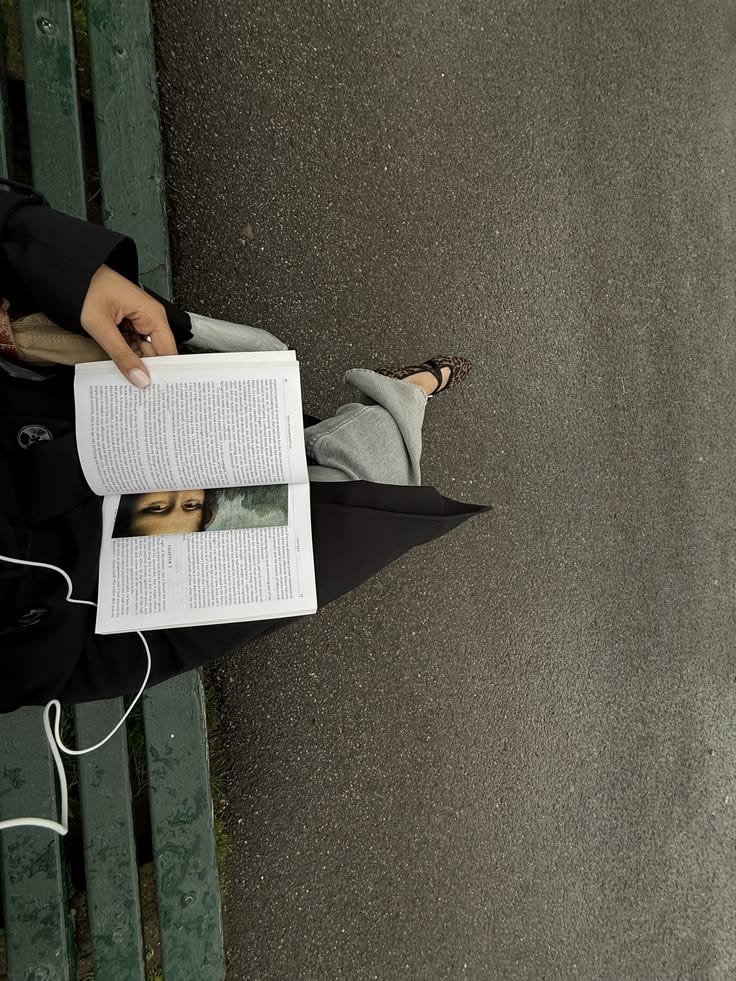
I have tried reading nonfiction.
I really have. I have bought books with titles that sound like they could fix my entire existence in six weeks. Books about discipline, emotional intelligence, human behaviour, and becoming the sort of woman who wakes up at five in the morning and drinks water as though she has personally invented hydration.
and I respect them. I do.
But somewhere around page forty, I begin to feel like I am being managed by a very polite stranger.
Fiction, on the other hand, has never once asked me to become a better person. It has simply introduced me to a terrible man, a woman with unresolved childhood trauma, and a family that should absolutely be investigated by social services. And somehow, by the end of it, I understand something about myself that three chapters on self-awareness couldn't get through my thick skull.
I think I have learned more about being human from fictional people than from actual human beings. Which is a slightly embarrassing admission, considering I am a human being myself. One would assume I had access to the subject.
But people are remarkably bad at explaining themselves. We lie. We perform. We say I'm fine with the conviction of a woman who has just committed a financial crime. We give TED Talks about boundaries and then answer a text from someone who has made our lives resemble a poorly managed government department.
Fiction doesn't necessarily make people look better. It makes them make sense
and that distinction has changed the way I read, the way I observe people, and, occasionally, the way I judge them.
A novel will spend three hundred pages showing you how someone became the person they are. Not to excuse them. Not to absolve them. Just to show you the long, humiliating, deeply human journey between something happened to me and now I am doing it to someone else.
That is a lesson I find much harder to learn from nonfiction, where people tend to arrive at their conclusions looking suspiciously well-adjusted.
In fiction, I have met people I would never want in my life but would happily spend an entire evening studying. People who are selfish, cowardly, cruel, delusional, and occasionally so stupid that I have to put the book down and stare at a wall. Yet I understand them. I understand the little stories they tell themselves to sleep at night. I understand how a person can mistake control for love, attention for affection, and being wanted for being known.
I have also learned that intelligence is not protection against stupidity. Some of the most intelligent characters make the most spectacularly idiotic decisions. They can analyse an entire room, detect a lie in three sentences, and still ruin their lives over a man whose primary personality trait is owning a leather jacket.
Which, frankly, is comforting.
There is something almost insulting about advice that assumes knowing better means doing better. If that were true, half the population would be emotionally stable, and I would have considerably fewer books to read.
Fiction understands that people can know exactly what they are doing and do it anyway. That we can recognise a pattern while actively participating in it. That self-awareness is not a cure; sometimes it is just having a front-row seat to your own terrible decisions.
I find that far more useful than being told to identify my limiting beliefs.
And then there is grief.
Nonfiction can explain the stages of grief, the psychology of loss, the neurological effects of heartbreak. All of that is valuable. I am not suggesting we replace research with a novel about a woman who cries in a supermarket.
But fiction can make you understand why someone stands in a supermarket crying over a packet of biscuits.
It can show you how grief makes ordinary life feel vaguely offensive. How you can be having the most normal Tuesday of your life and suddenly remember that someone is dead, or gone, or no longer the person you knew. How the world continues to sell discounted laundry detergent while your entire internal universe has collapsed.
You don't merely learn that grief changes people. You begin to recognise the strange, unphotogenic ways it does.
And perhaps that is what fiction does best. It gives emotional experiences a body. It takes an idea you could understand intellectually and makes you live inside it for a while.
You can read that loneliness is a universal human experience. Or you can spend four hundred pages with a character who has a full social calendar, a decent apartment, and absolutely nobody they can call when something terrible happens.
One is information. The other is an uncomfortable mirror.
I don't think fiction makes me more moral, either. That would be a rather grand claim for someone whose reading habits include an alarming number of fictional murders. But it has made me more suspicious of simple explanations. More patient with contradictions. Less convinced that a person can be understood through the worst thing they have done, or the best thing they have said.
It has also made me realise that people are not always the most reliable narrators of their own lives.
Including me.
Especially ME.
We edit ourselves constantly. We make ourselves the reasonable one in every argument. We remember the things that support our version of events and develop sudden amnesia around the parts where we were being insufferable. We turn our mistakes into character development and other people's mistakes into evidence of poor character.
A good novel catches people doing this.
Sometimes the narrator is lying to you. Sometimes they are lying to themselves. Sometimes they are telling the truth as they understand it, which is considerably more dangerous.
And suddenly you start wondering how much of your own life is being narrated by a person who desperately wants to look innocent.
I find this more intellectually stimulating than most advice about personal growth. It doesn't hand me a checklist. It makes me question the person holding the pen.
Of course, fiction can be ridiculous. It can romanticise terrible behaviour, make emotionally unavailable men look like architectural achievements, and convince perfectly sensible women that a man who hasn't spoken in three days is probably just processing his feelings in a beautifully lit apartment.
I am not immune. I have read enough novels to know that if a fictional man has a tragic past, a mysterious job, and the ability to communicate exclusively through eye contact, I should probably call a friend.
But that is another thing fiction has taught me: the difference between understanding a character and wanting to date one.
A distinction society would benefit from making more often.
I don't read fiction because I believe every novel contains some profound truth about the universe. Some novels are simply entertaining. Some are badly written. Some are about people making decisions so incomprehensible that I begin to suspect the author has a personal vendetta against common sense.
I read because I like being taken somewhere I couldn't have reached on my own. Because I want to see what happens when someone else's mind is given enough space to unfold. Because the world is already full of people telling me what to think, and I find it refreshing to spend time with a book that lets me do the thinking myself.
Nonfiction often gives me answers.
Fiction makes me suspicious of the questions.
And I think that is why I keep returning to it.
I don't necessarily finish a novel feeling wiser. Sometimes I finish feeling devastated, mildly nauseous, and personally offended by the ending. Sometimes I close the book and spend the next twenty minutes staring into the middle distance like a woman who has just received an unexpected tax notice.
But every now and then, a character does something, or says something, or reveals some small, ugly truth about themselves, and I recognise it.
Not in them.
In me.
And there is no self-help book in the world that can compete with the experience of realising you have been quietly identifying with the villain for the last two hundred pages.
So yes, I think I have learned more from fiction than nonfiction.
Not because facts are unimportant, or because expertise is overrated, or because I believe a fictional woman with a complicated relationship with her mother should be permitted to advise me on economics.
I simply think there are things you cannot learn by being told.
You have to watch someone make the mistake. You have to understand why they made it. You have to sit with the consequences long enough to recognise the shape of them.
And sometimes, you have to fall in love with a character, only to discover that you have fallen in love with a walking collection of red flags.
Which is, admittedly, a very expensive way to learn about human behaviour.
But at least the book doesn't ask me to split the bill.
This is exactly why I reach for a novel over a self help book most days. Fiction doesn't fix anyone, it just shows you how they got there. And the bit about broody fictional men being written like beautiful buildings made me laugh out loud, we've all fallen for at least one 😅